Arabic text to speech · العربية
Arabic text to speech reader, free in Chrome
Voq reads Arabic webpages aloud in a natural AI voice — news, Arabic Wikipedia, AI chats, long articles. Press play below to hear it.
- Natural Arabic voice
- No account
- Free every day
By the Voq team · Facts checked 22 October 2026
مرحبًا، أنا Voq. أقرأ لك محتوى الويب بصوت عالٍ لتريح عينيك. إجابات ChatGPT، ونقاشات Reddit، والمقالات الطويلة: بنقرة واحدة أقرؤها لك بصوت طبيعي. أتحدث لغات كثيرة، وأنا مجاني تمامًا، ولا حاجة لإنشاء حساب. استمع أثناء الطهي أو التنقل أو الاسترخاء. إذا كانت القراءة مرهقة، فدعني أقوم بها عنك. أضف Voq إلى Chrome واستمع إلى أي صفحة في ثوانٍ.
Tip: click any word to jump there
This is Voq reading Arabic. Press play.
What it's saying, in English
Hi, I'm Voq. I read the web out loud, so your eyes can take a break. ChatGPT answers, Reddit threads, long articles: one click, and I'll read them to you in a natural voice. I speak many languages, I'm completely free, and there's no account to create. Listen while you cook, commute, or just rest. If reading feels like work, let me do it for you. Add Voq to Chrome and hear any page in seconds.
How Voq reads Arabic
One natural Arabic voice
Voq reads Arabic with Google's multi-region Arabic voice, a Google Cloud AI voice. It reads whole phrases with natural rhythm rather than sounding out one letter at a time.
No pasting, no uploading
Open an Arabic page in Chrome and press play. With the language on Auto, Voq notices the Arabic script and switches to Arabic by itself.
Highlighting as it reads
Each word lights up as it is spoken, so you can keep your place in right-to-left text and hear how the voice reads a word written without vowel marks.
Voq reading Arabic
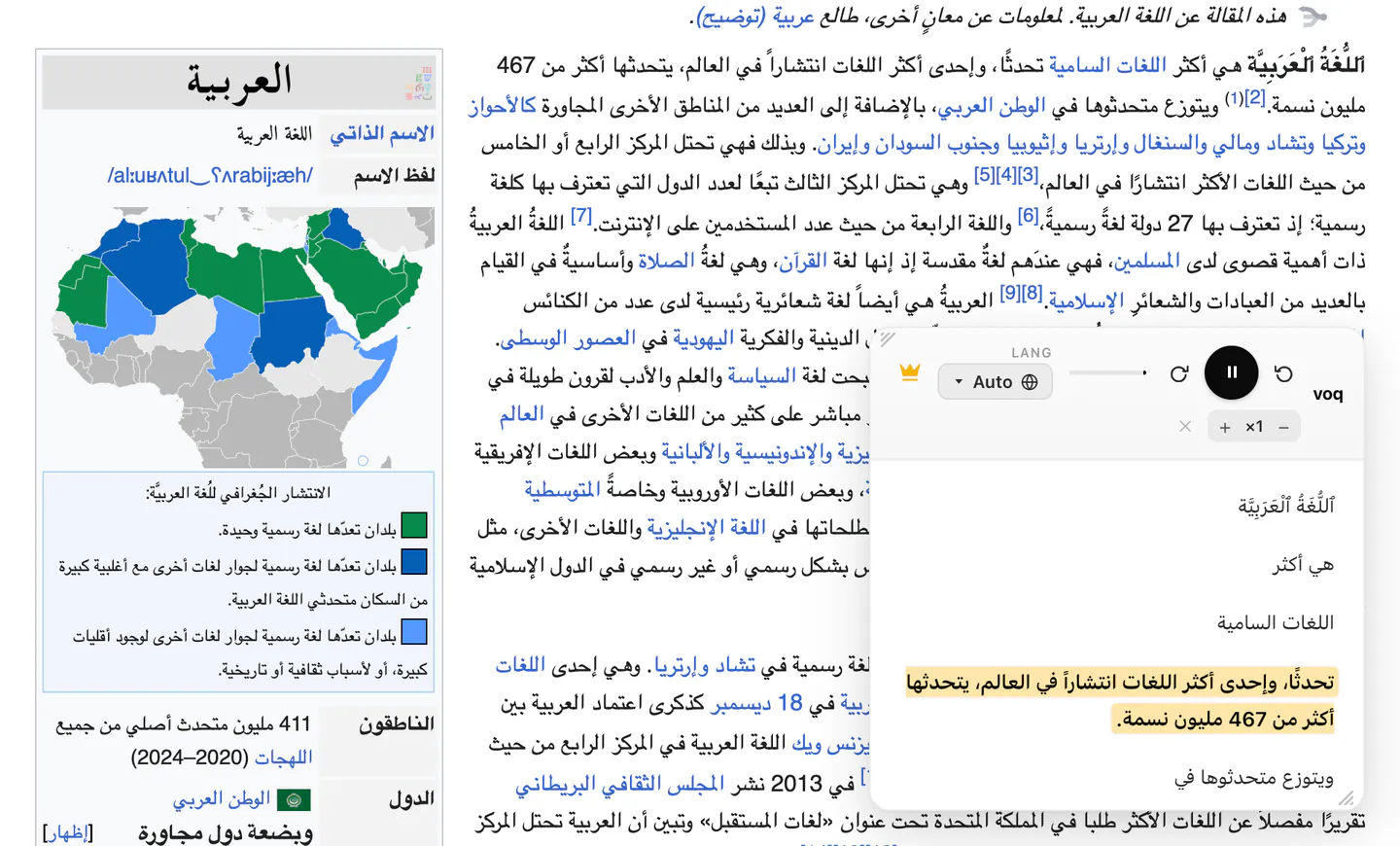
Where you'll use it
Arabic news sites
Front-page stories, analysis and opinion columns from Arabic-language news sites — written in formal Arabic and comfortable to listen to while you do something else.
ويكيبيديا, Arabic Wikipedia
Long encyclopedia articles on history, science and geography, read out in full. Good for hearing names and technical terms that rarely carry vowel marks.
Replies from AI assistants
Ask Gemini, ChatGPT or Claude a question in Arabic and listen to the answer instead of reading it. Our Gemini guide shows the steps.
Forums and comment threads
Arabic Q&A pages, discussion threads and comments, read from top to bottom. The Reddit read-aloud guide shows how Voq handles a long thread.
Arabic, read aloud: what to know
Arabic is used by more than 422 million people in the Arab world, according to UNESCO figures quoted by the United Nations Office at Nairobi, and it has been one of the UN's six official languages since 1973. It is also a language where the page leaves a lot unsaid: most vowels are missing, and the same letters can stand for different words. A voice reading along fills those gaps.
- 28 letters, written right to left. The Arabic alphabet has 28 basic letters, joined in a cursive script. Most letters have up to four shapes — on their own, at the start, in the middle or at the end of a word — and six (ا د ذ ر ز و) never join to the letter after them. Some letters differ only in their dots: ب is "b", ت is "t" and ث is "th".
- Short vowels are usually left out. Newspapers, websites and most books are written without the short-vowel marks (ḥarakāt); readers supply them from context. So دين can be dīn, "religion", or dayn, "debt". Full vowel marks appear mainly in the Qur'an, children's books and texts for learners.
- Heavy and light consonants are different words. Arabic has "emphatic" consonants, which also darken the vowels next to them. Swap one for its plain partner and the word changes: سيف (sayf) is a sword but صيف (ṣayf) is summer, and تين (tīn) means figs while طين (ṭīn) means mud.
- "Al-" doesn't always sound like "al". Before the 14 "sun letters" the l of the article الـ disappears into the next consonant, which is doubled: الشمس (the sun) is "ash-shams". Before the 14 "moon letters" it stays: القمر (the moon) is "al-qamar". The spelling is the same in both cases, so you only learn it by ear.
- A silent letter at the end of many words. The feminine ending ة (tā' marbūṭa) looks like a t, but in Modern Standard Arabic it is usually silent or heard as a soft h at the end of a phrase, and is only said as "t" when a case ending is pronounced or the word is bound to the noun after it.
- Formal Arabic and the dialects. Modern Standard Arabic is the language of news, administration, law and books; people talk to each other in local dialects. They differ in sound as well as words: ق is a "q" sound in standard Arabic but a hard "g" in Gulf dialects, and "thank you" is شكرا (shukran) in standard Arabic but يعيشك (ya'īshak) in Tunisia.
Learning Arabic? Listen while you read
- 1Hear the sun letters in the demo
In the sample above, الطهي (cooking) starts with a sun letter, so it sounds like "aṭ-ṭahy", while المقالات (articles) starts with a moon letter and keeps its "al-". Replay the sentence and listen for the difference.
- 2Practise reading without vowel marks
Most real Arabic text has no ḥarakāt. Read a short paragraph yourself, guessing the vowels, then press play and check each word against the voice. The words you got wrong show you which patterns to learn next.
- 3Train your ear for emphatics
The demo's بصوت (in a voice) contains ص, an emphatic s. Listen to how it darkens the vowel after it, then look for pairs like سيف and صيف in your own reading.
Is Voq the right Arabic text to speech tool?
A good fit if you want to
- Listen to Arabic websites in Chrome without copying anything
- Hear Arabic text spoken while each word is highlighted
- A free Arabic reader with no account, for listening practice or to rest your eyes
Use something else if you need
- An Arabic MP3 or WAV file for a video, podcast or lesson — Voq has no audio export
- Scanned pages, images or calligraphy — text in images needs OCR, which Voq doesn't have
- A specific dialect voice, such as Egyptian or Gulf Arabic, or a choice between several voices
Voq vs voice generator sites
| Feature | Voq | voice generator sites |
|---|---|---|
| Reads the webpage you are on | Yes — press play on the page itself | No — you paste or upload the text |
| Download audio | No audio export | Yes — MP3 and WAV; Narakeet also M4A, TTS.ai also OGG and FLAC |
| Arabic voices | One voice | Narakeet says 119 voices (15 labelled Arabic) · TTS.ai lists 3 voices |
| Dialect voices | No — one multi-region voice | Narakeet labels Emirati, Egyptian, Iraqi, Tunisian, Lebanese and Omani voices |
| Account | Never needed | Narakeet: no registration to try · TTS.ai: some models free without an account |
| Price | Free every day · $2/mo founding rate lifts the limit | Free trial or allowance, then paid plans or credits |
Voice generator details from Narakeet and TTS.ai, checked 22 October 2026. Choose a voice generator if you need an audio file or a dialect voice; choose Voq if you want Arabic pages read to you while you browse.
Start in 3 steps
- 1Add Voq to ChromeFree, no sign-up
- 2Open a page in your languageNews, Wikipedia, AI chats…
- 3Press playVoq detects the language and highlights each word
Arabic text to speech: FAQ
Is there a free Arabic text to speech reader for Chrome?
Yes — Voq has a free daily allowance. Listening every day costs nothing up to the daily limit. The $2/month founding rate removes that limit if you need more.
How do I make Chrome read Arabic text aloud?
Add Voq, open the page, press play. On Auto, Voq recognises Arabic script by itself; you can also choose Arabic in the language menu.
Which dialect does the Arabic voice speak?
It is one multi-region voice. Voq uses Google's multi-region Arabic voice rather than a voice tied to one country. Play the demo above to hear whether it suits what you read.
Does it read Arabic without harakat?
Most web text has none — try the demo. The sample above is written without vowel marks on most words, and it is the voice the extension uses. Listen to it before relying on it for study.
Can Voq read Arabic in images or scanned books?
No. Voq reads text that is on the page. Words inside images, scans or calligraphy need OCR, which Voq doesn't have.
Can I export Arabic speech as an MP3?
No. Voq only reads aloud in Chrome. For an audio file — a voice-over or a recorded lesson — use a voice generator instead.
Do I have to create an account?
No. Voq works without signing up. Paying for the founding rate gets you an activation code, not an account.
Will it help me learn Arabic?
As a listening aid, yes. Following the highlight while the voice reads shows you the vowels the script leaves out. It works best alongside a course or a teacher.
Other languages
Voq speaks 34 languages. See them all.
Sources
- United Nations Office at Nairobi: International Day of the Arabic Language 2016 (UNESCO figure, UN official language since 1973)
- Wikipedia: Arabic alphabet (28 letters, letter forms, tā' marbūṭa)
- Wikipedia: Arabic diacritics (unvowelled text, دين)
- Elon.io: Arabic emphatic consonants (سيف/صيف, تين/طين)
- Fluent Arabic: sun and moon letters
- Arabikey: Modern Standard Arabic and the dialects
- Narakeet: Arabic text to speech
- TTS.ai: Arabic text to speech
Speaker figure from UNESCO as quoted by the UN Office at Nairobi (2016). Script and pronunciation facts from the references above. Voice generator details from their own pages. Facts checked 22 October 2026.
Hear Arabic in one click
Free every day · No account · 34 languages
Add to Chrome — It's FreeMore: Use cases · Platform guides · Compare · Pricing