Turkish text to speech · Türkçe
Turkish text to speech reader, free in Chrome
Voq reads Turkish webpages aloud in a natural voice with an accent from Turkey — news, Turkish Wikipedia, AI chat answers, long articles. Play the sample below to hear the voice first.
- Voice from Turkey
- No sign-up
- Free every day
By the Voq team · Facts checked 26 October 2026
Merhaba, ben Voq. Gözlerin dinlenebilsin diye interneti sesli okurum. ChatGPT yanıtları, Reddit başlıkları, uzun makaleler: tek tıkla hepsini doğal bir sesle sana okurum. Birçok dil konuşurum, tamamen ücretsizim ve hesap açman gerekmez. Yemek yaparken, yoldayken ya da dinlenirken dinle. Okumak yorucu geliyorsa, bu işi bana bırak. Voq'u Chrome'a ekle ve herhangi bir sayfayı saniyeler içinde dinle.
Tip: click any word to jump there
This is Voq reading Turkish. Press play.
What it's saying, in English
Hi, I'm Voq. I read the web out loud, so your eyes can take a break. ChatGPT answers, Reddit threads, long articles: one click, and I'll read them to you in a natural voice. I speak many languages, I'm completely free, and there's no account to create. Listen while you cook, commute, or just rest. If reading feels like work, let me do it for you. Add Voq to Chrome and hear any page in seconds.
How Voq reads Turkish
A natural voice from Turkey
Turkish pages are spoken by a Google Cloud AI voice whose accent is from Turkey, with the flow of real sentences rather than a string of isolated words.
Press play where you are
No copy, no paste, no upload. On a Turkish site, press play; left on Auto, Voq tells that the text is Turkish and reaches for the Turkish voice by itself.
Watch the words go by
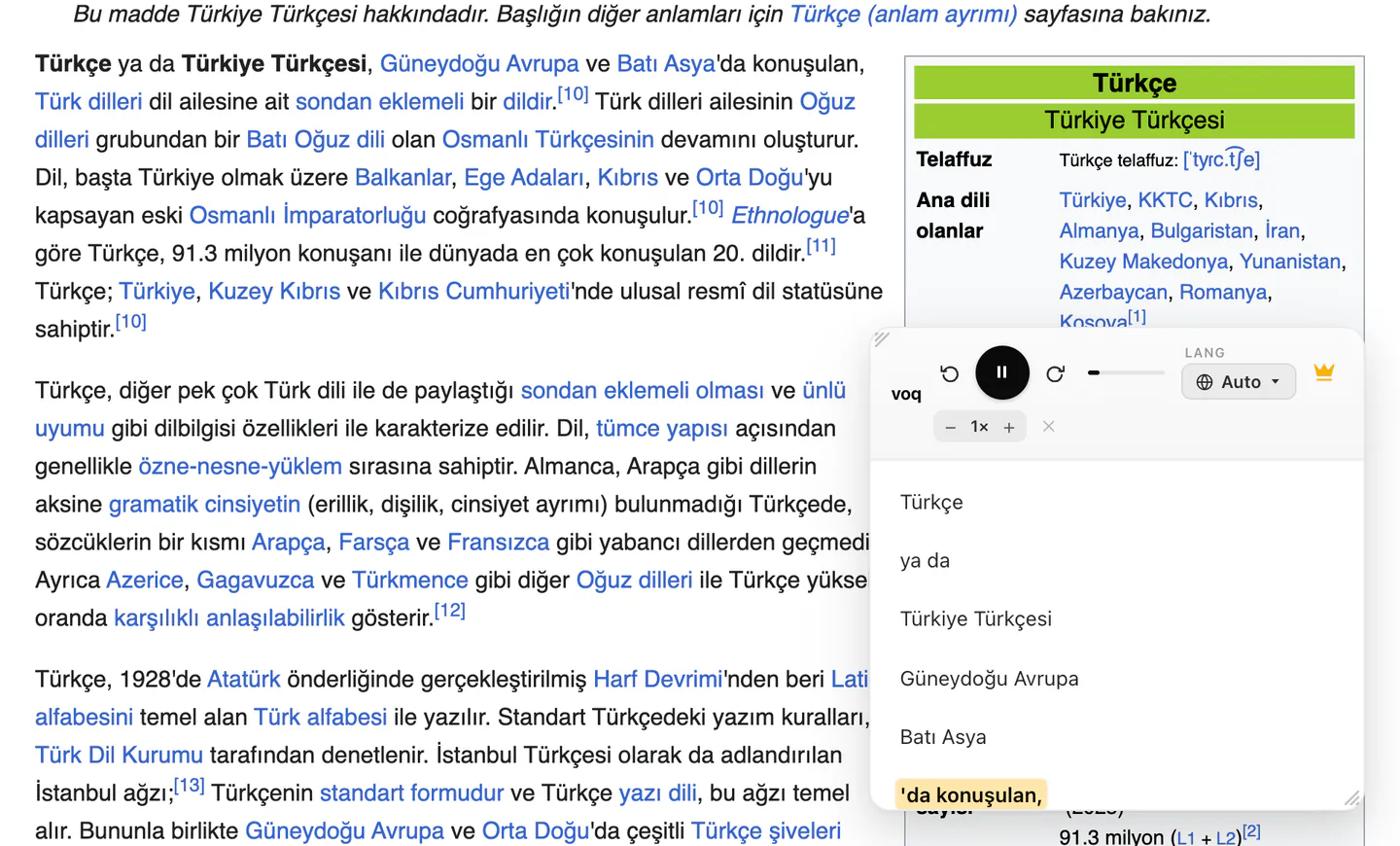
Voq marks each word on the page as the voice reaches it — useful in Turkish, where a single long word can carry a whole phrase of suffixes and your eyes can easily slip off the line.
Voq reading Turkish
Where you'll use it
Turkish news and columns
Daily headlines, opinion columns and long features from Turkish outlets, heard on the ferry, on a walk or while the tea brews.
Türkçe Vikipedi
Long articles on Ottoman history, Anatolian cities and Turkish literature, read aloud from the first heading to the last.
Chatbot replies in Turkish
Ask ChatGPT, Gemini or Claude a question in Turkish and hear the reply without reading a wall of text. Here is how to use Voq on ChatGPT.
Turkish forums and reviews
Community boards, shop reviews and comment sections in Turkish, listened to one entry after another.
Turkish, read aloud: what to know
Turkish is the official language of Turkey and is also official in Cyprus and Northern Cyprus, with recognised minority status in countries such as Greece, North Macedonia and Romania (Wikipedia). About 90 million people speak it, according to Ethnologue figures cited by Britannica, and the standard language is based on the speech of Istanbul. Turkish spelling is close to phonetic, so once you know what each letter does, the page and the sound line up — and hearing it read is the fastest route to knowing what each letter does.
- A young, phonetic alphabet. Turkish has been written in Latin letters only since 1928, when the Arabic-based Ottoman script was replaced. The 29-letter alphabet has no q, w or x, adds ç, ş, ğ, ı, ö and ü, and gives each letter one sound — so a word is said the way it is spelled.
- ı and i are different letters. The dotless ı is a short "uh", close to the vowel in "fuss"; the dotted i is "ee". The difference carries into capitals too: I is the capital of ı, and İ — as in İstanbul — is the capital of i. Compare kadın (woman), with ı, and kedi (cat), with i.
- c is "j", ç is "ch", ş is "sh". The plain c surprises most English readers: the name Can sounds like "John" and Cem like "gem". The cedilla changes the sound — ç as in "church", ş as in "show".
- The soft g (ğ) is barely there. ğ is not pronounced as a g: it stretches the vowel before it, and between two vowels it nearly disappears, as in soğuk (cold). That is the only difference between tura (drumstick) and tuğra (a sultan's monogram) — the second has a longer u.
- Vowel harmony shapes every ending. Suffixes change their vowel to match the word: kediler (cats) but kadınlar (women), etsiz (without meat) but tuzsuz (without salt). Since Turkish builds words by stacking suffixes, harmony runs through very long words — Wikipedia's showcase example, Çekoslovakyalılaştıramadıklarımızdanmışsınızcasına, is a single word.
- Stress usually lands at the end — with exceptions. Most words stress the last syllable, so çocuklar (children) peaks on -lar. Many place names break the rule: an-KA-ra is stressed on its second syllable, and İs-TAN-bul on the middle one. Some suffixes push the stress forward too: gidiyor (is going) is stressed on -di-, but the negative gitmiyor on git-.
Learning Turkish? Listen while you read
- 1Hear harmony in one sentence of the demo
The sample lists uzun makaleler (long articles) right after Reddit başlıkları (Reddit threads): the same plural comes out as -ler after the e of makale and as -lar after the ı of başlık. Replay it and the rule is in your ear before you have read it in a grammar.
- 2Listen for the missing ğ
In the demo, doğal (natural) has no g sound at all — just a longer o before the -al. Watch the highlight on doğal, then look for ğ in your next article and check whether you hear it.
- 3Catch the stress shift on -ken
The demo says yoldayken (while on the road). -ken is one of the endings that pulls the stress onto the syllable before it, the way evdeyken (while at home) is stressed on -de-. Note other -ken words as you listen and mark where the stress falls.
Is Voq the right Turkish text to speech tool?
A good fit if you want to
- Hearing Turkish sites in Chrome right where you are reading them, with nothing to paste
- Linking Turkish spelling to sound — ı, ğ, c, ç, ş — while each word is highlighted
- Free Turkish listening every day, for language practice or a break from the screen, with no account
Use something else if you need
- A Turkish audio file (MP3, WAV) for a lesson, an ad or a voice-over — Voq has no audio export
- Turkish text inside an image or a scanned page — that needs OCR, which Voq lacks
- Several Turkish voices to pick from, male and female — Voq offers one Turkish voice
Voq vs voice generator sites
| Feature | Voq | voice generator sites |
|---|---|---|
| Reads the webpage you are on | Yes — press play on the page | No — paste or upload your text first |
| Audio file to download | No audio export | Yes — Narakeet: MP3, WAV, M4A · TTS.ai: MP3, WAV, OGG, FLAC |
| Turkish voices | One voice from Turkey | Narakeet says 112 · TTS.ai lists 4 |
| Account | None, ever | Narakeet: no registration to try · TTS.ai: free models without signing up |
| Price | Free every day · $2/mo founding rate removes the limit | Free to try, with paid options on both sites |
Generator details are taken from Narakeet and TTS.ai's Turkish page, checked 26 October 2026. For an audio file to keep or a choice between Turkish voices, a voice generator does the job better; for hearing Turkish pages while you browse, Voq does.
Start in 3 steps
- 1Add Voq to ChromeFree, no sign-up
- 2Open a page in your languageNews, Wikipedia, AI chats…
- 3Press playVoq detects the language and highlights each word
Turkish text to speech: FAQ
Is there a free Turkish text to speech tool for Chrome?
Yes — Voq, free every day up to a listening limit. You use it without an account. Heavy listeners can pay the $2/month founding rate to remove the daily cap.
How do I make a Turkish page read aloud?
Add Voq to Chrome, open the page, press play. Auto recognises Turkish on its own, or you can choose Turkish in the language menu.
What accent does Voq's Turkish voice have?
An accent from Turkey. Voq has a single Turkish voice: press play on the Turkish sample in the hero and you are hearing exactly what the extension uses.
Can I download Turkish speech as an MP3?
No. Voq is for listening in the browser and creates no audio files. To get a file, use a voice generator.
Will Voq read Turkish in a picture or a scanned page?
No. Text has to be real text on a webpage. Reading words out of images or scans takes OCR, which is not part of Voq.
Does Voq need a login?
No. You never create an account. Unlimited listening is activated with a code you get after paying — no password involved.
Can Voq help me learn Turkish?
Yes, for listening. Following the highlight lets you hear vowel harmony, the silent ğ and the shifting stress in real sentences. Treat it as practice alongside lessons, not a course.
Other languages
Voq speaks 34 languages. See them all.
Sources
- Wikipedia: Turkish language (official status, 1928 alphabet, harmony, long-word example)
- Britannica: Languages by total number of speakers (Ethnologue, early 2020s)
- Babbel: Tricky Turkish pronunciation (ı, ğ, c, ç, ş)
- Turkey Travel Planner: Turkish pronunciation (c, ı, ğ, tura/tuğra)
- Turkish Tea Time: Vowel harmony
- Elon.io: Turkish stress exceptions and pre-stressing suffixes
- Narakeet: Turkish text to speech
- TTS.ai: Turkish text to speech
Official status, alphabet history and the long-word example from Wikipedia; the speaker total (about 90 million) is the Ethnologue figure listed by Britannica and matches Wikipedia's 91 million. Pronunciation, harmony and stress examples from the references above. Voice generator details from their own pages. Facts checked 26 October 2026.
Hear Turkish in one click
Free every day · No account · 34 languages
Add to Chrome — It's FreeMore: Use cases · Platform guides · Compare · Pricing