Filipino text to speech · Filipino
Filipino text to speech reader, free in Chrome
Voq reads Filipino pages aloud in an AI voice from the Philippines. Open a news story, a Wikipedia article or an AI answer in Filipino and press play. Press play on the sample below to hear the voice before you add anything.
- Voice from the Philippines
- Nothing to paste
- Free every day
By the Voq team · Facts checked 5 November 2026
Kumusta, ako si Voq. Binabasa ko nang malakas ang web para makapagpahinga ang mga mata mo. Mga sagot ng ChatGPT, mga thread sa Reddit, mahahabang artikulo: isang click lang, at babasahin ko ang mga ito sa natural na boses. Marami akong wikang alam, libre ako, at hindi mo kailangang gumawa ng account. Makinig habang nagluluto, bumibiyahe, o nagpapahinga. Kung nakakapagod magbasa, ako na ang bahala. Idagdag ang Voq sa Chrome at pakinggan ang kahit anong page sa loob ng ilang segundo.
Tip: click any word to jump there
This is Voq reading Filipino. Press play.
What it's saying, in English
Hi, I'm Voq. I read the web out loud, so your eyes can take a break. ChatGPT answers, Reddit threads, long articles: one click, and I'll read them to you in a natural voice. I speak many languages, I'm completely free, and there's no account to create. Listen while you cook, commute, or just rest. If reading feels like work, let me do it for you. Add Voq to Chrome and hear any page in seconds.
How Voq reads Filipino
One voice, from the Philippines
The Filipino voice is a Google Cloud voice with a Philippines accent. You get a single voice, and the sample above is the same one the extension uses.
Reads the page you have open
There is nothing to paste. Go to a Filipino site and press play. Auto recognises the language, or pick Filipino in the language menu.
The reading panel follows along
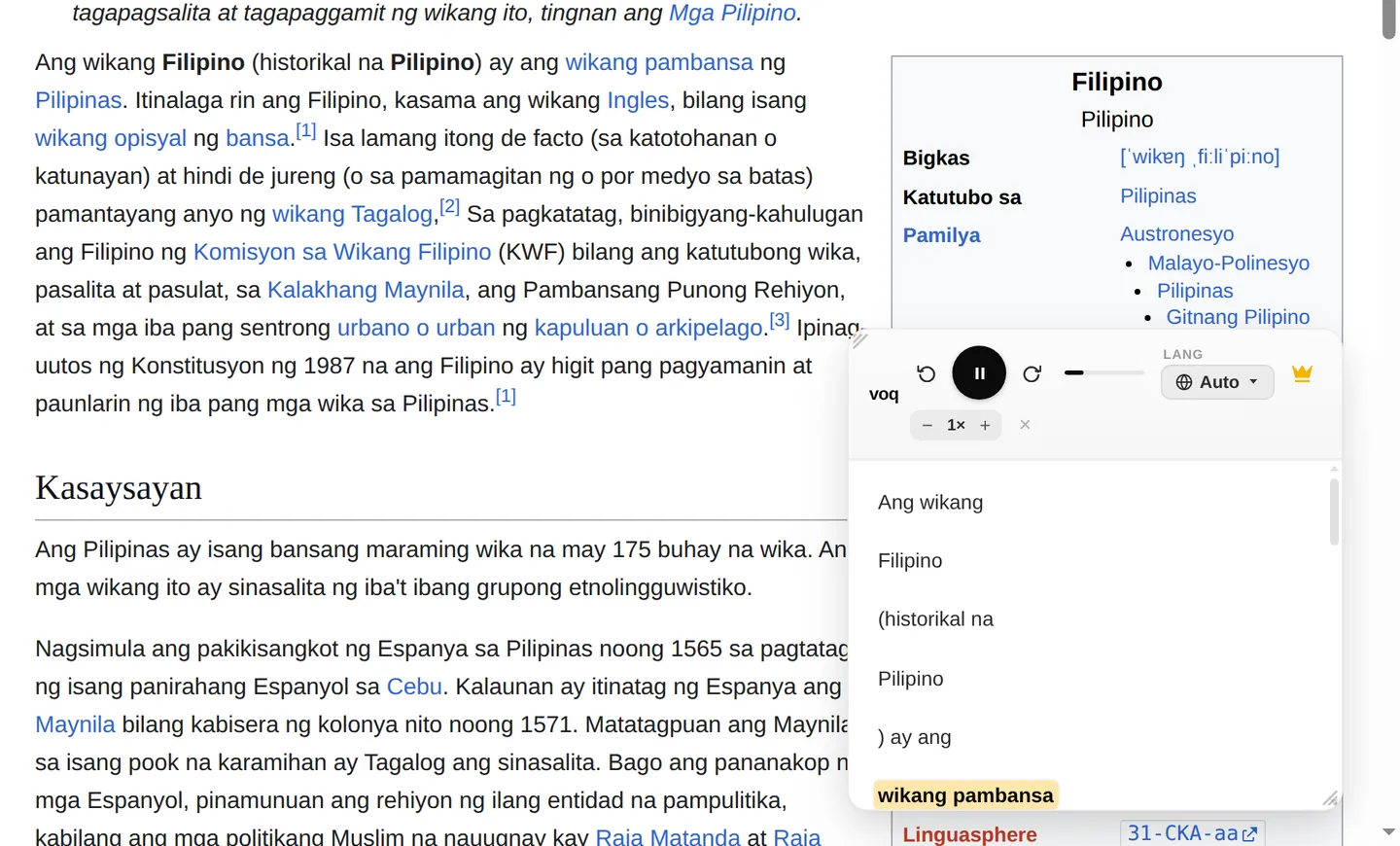
Each word is highlighted as it is spoken. Filipino words are often long with affixes and repeated syllables, so a moving marker keeps your place.
Voq reading Filipino
Where you'll use it
Filipino news sites
Daily reports, columns and features, for the jeepney ride, the kitchen or an eye break.
Filipino-language Wikipedia
Articles on places, history and people, when you want to hear how a place name is said.
AI answers in Filipino
Put a question to an assistant in Filipino and hear the answer. Here is how to read ChatGPT aloud.
Forums and social threads
Comment sections and Reddit threads in Filipino, from the first post to the last reply.
Filipino, read aloud: what to know
Filipino is the national language of the Philippines and, with English, one of its two official languages. Wikipedia counts about 29 million first-language speakers (2010) and 54 million second-language speakers (2020). It is a standardised form of Tagalog, and the two share identical grammar, phonology and core vocabulary (Wikipedia). Most of the spelling is easy to read aloud, but stress and a hidden stop can change a word.
- Stress and a catch in the throat change the word. Identical spelling can hide different words, depending on stress and a final glottal stop: baka (cow) and baká (possible), pito (whistle) and pitó (seven), kaya (can) and kayâ (so). Stress falls on either the last or the second-to-last syllable, and the vowel of a stressed syllable is lengthened except at the end of a word.
- The glottal stop is usually not written. It is the brief catch in the throat that closes a word like hindi. A hyphen shows it after a consonant, as in mag-uwî (to return home). Accent marks such as the grave and the circumflex show it in formal and academic writing, so everyday text leaves you to know the word.
- Ng is one letter, and ng is also a word. The modern alphabet has 28 letters: the 26 of the basic Latin alphabet, the Spanish Ñ and the digraph Ng. The sound is the one at the end of English "sing", but Filipino also uses it to begin words: ngiti (smile). The small word ng, as in gusto ko ng kape, is said like nang.
- Five vowels, with e and i sharing a seat. Written Filipino uses a, e, i, o and u. E and i, and o and u, can be interchangeable in spelling: pangit is also written panget.
- Loanword letters keep their sounds. The letters f, v and z are accepted in loanwords such as fakulti, varayti and zoolohiya, though some speakers say them as p, b and s, and older loans were respelled, like porma from Spanish forma. Spanish ñ usually turns into ny: España becomes Espanya.
- D and r are close relatives. The r sound is traditionally an allophone of d, a tap that appears in words such as saráp (deliciousness) and kuryente (electricity).
Learning Filipino? Listen while you read
- 1Hear the ng in wikang and isang
The sample uses wikang and isang. Both end in the ng sound of English "sing". Follow the highlight and notice that the ng is one sound, not an n followed by a g.
- 2Listen to the end of hindi
Hindi (not) ends with a glottal stop. Formal spelling can show it as hindî. The sample says hindi mo kailangang, so listen for the short stop at the end of hindi before mo.
- 3Compare nang and ng
The sample says nang malakas (loudly). The little word ng, which is not spelled with an a, is also said like nang. Hear the sample once with the highlight on and the two spellings click together.
Is Voq the right Filipino text to speech tool?
A good fit if you want to
- Filipino articles, encyclopedia entries and AI replies spoken from the tab you are on
- Tracking long Filipino words on the page as they are spoken
- A no-account, free-every-day reader for anyone learning Filipino or resting their eyes
Use something else if you need
- A Filipino voice-over saved as a file; Voq cannot export audio
- Filipino text inside a photo or a scan; Voq has no OCR and reads text you can select
- A choice of voices or a particular regional accent; Voq has one Filipino voice, from the Philippines
Voq vs voice generator sites
| Feature | Voq | voice generator sites |
|---|---|---|
| Reads the tab you have open | Yes, in your open tab | No, text goes in first by paste or upload |
| Downloadable audio | No export | Yes: Narakeet lists m4a, mp3 and wav; Fliki offers MP3 on every plan and WAV on paid plans |
| Filipino voices | One voice from the Philippines | Fliki lists 2; Narakeet states 78, 72 of them tagged Polyglot; ElevenLabs names five on the page |
| Account | None, ever | Narakeet: no registration required · ElevenLabs: sign up for free |
| Price | Free every day · $2/mo founding rate removes the limit | Free tier, then paid plans or credits |
Generator details come from Narakeet, Fliki and ElevenLabs, checked 5 November 2026. Choose one of them if you need a Filipino audio file or a choice of voices. Choose Voq if you simply want Filipino pages spoken as you browse.
Start in 3 steps
- 1Add Voq to ChromeFree, no sign-up
- 2Open a page in your languageNews, Wikipedia, AI chats…
- 3Press playVoq detects the language and highlights each word
Filipino text to speech: FAQ
Is there a free Filipino text to speech reader?
Yes, Voq is free every day. Free listening comes with a daily limit, and the founding rate of $2 a month removes it.
Is this the same as Tagalog text to speech?
Very nearly. Filipino is a standardised form of Tagalog with the same grammar and phonology. Voq lists the language as Filipino.
What accent does the Filipino voice have?
A Philippines accent. There is a single Filipino voice, so there are no regional voices to choose between.
How do I have Chrome read Filipino pages aloud?
Add Voq, open the page, press play. Auto spots Filipino, or you can pick it in the language menu.
Can I download Filipino speech as an MP3?
No. Voq speaks inside Chrome and never creates an audio file. A voice generator is the route to a Filipino MP3.
Does it read Filipino in images or scans?
No. Voq has no OCR, so lettering baked into a picture stays silent. Only text you can select is read.
Will it say words like baka and baká differently?
Play the sample and judge. Stress is usually not marked in everyday text, so the sample is the extension's own voice to test before you rely on it.
Is it useful for learning Filipino?
Yes, as listening practice. Reading along while a word is spoken ties spelling to sound. Lessons are still the place for grammar and conversation.
Other languages
Voq speaks 34 languages. See them all.
Sources
- Wikipedia: Filipino language (speakers, status, relation to Tagalog)
- Wikipedia: Tagalog phonology (stress, glottal stop, ng, loan sounds)
- Filipino alphabet (28 letters, Ñ and Ng, interchangeable vowels)
- LingQ: Tagalog pronunciation (ng said as nang, ñ as ny)
- Narakeet: Filipino text to speech
- Fliki: Filipino voices
- ElevenLabs: Filipino text to speech
Speaker numbers, national status and the relation to Tagalog from Wikipedia's Filipino language article. Stress, glottal stop, ng, vowels and loan sounds from Wikipedia's Tagalog phonology article, the 28-letter alphabet from a Wikipedia mirror, and the ng and ñ reading notes from LingQ. Voice generator details from their own pages. Facts checked 5 November 2026.
Hear Filipino in one click
Free every day · No account · 34 languages
Add to Chrome — It's FreeMore: Use cases · Platform guides · Compare · Pricing